6+ years publishing on Amazon KDP. Hundreds of books. Suspensions resolved. Questions answered on keywords, ads, pricing, ranking, and strategy.
Ask your question freeAll questions are anonymous. No card required.
6+
years on KDP
6-figure
annual sales
Suspensions
resolved
Free
for all users
Where the 6-figure comes from
This is the KDP Royalties Estimator for the account behind these answers, covering July 2020 to February 2026.
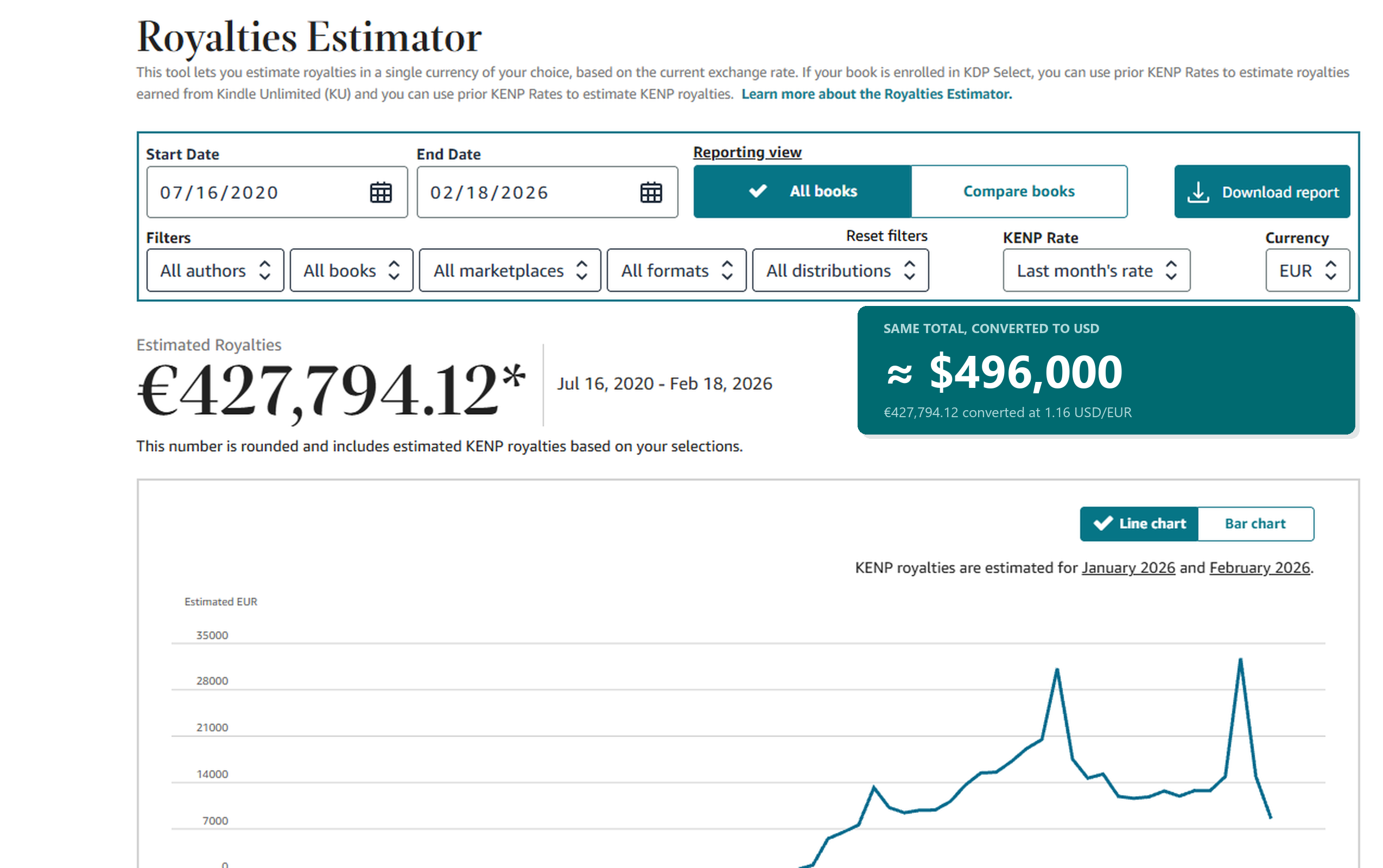
Screenshot from Amazon's own KDP dashboard. Click to open it full size. The dollar figure in the teal box is our conversion at 1.16 USD/EUR, not part of Amazon's report.
KDP put my book under review for 'content guidelines.' What do I do?
Do not unpublish. Email KDP with your case ID, the specific policy you believe you comply with, and any supporting evidence. Unpublishing before they decide resets the clock.
I got a KDP account suspension out of nowhere. I have no idea what I violated. What do I do?
Do not panic and do not fire off an emotional appeal. Read the suspension email carefully, they almost always name a specific policy even if it feels vague. The most common triggers: duplicate content, AI-assisted content without proper disclosure, misleading descriptions, and spiked review patterns. Write a calm, structured appeal that (1) acknowledges the policy cited, (2) explains what happened without excuses, and (3) details the specific steps you have taken. One well-structured appeal beats five emotional ones.
How many backend keywords should I use and can I repeat them from the title?
Use all 7 fields, up to 50 characters each. Never repeat words already in your title or subtitle as KDP indexes those automatically. Use the space for variations, misspellings, and related phrases.
How do I get my first reviews without violating Amazon terms?
The compliant way: build an ARC list before launch. These are readers who agree to read and leave an honest review in exchange for a free copy. iWrity is built specifically for this. You can also recruit from your own email list and from the back matter of books you have already published. What you cannot do: ask for positive reviews, offer incentives in exchange for a review, review-swap with other authors, or buy reviews from any service. Amazon cross-references reviewer accounts and gets smarter about this every year.
What is the minimum number of reviews before I raise my price?
10 reviews at 4 stars or higher is the threshold where price resistance drops meaningfully. Below that, buyers hesitate. Above that, the social proof does the selling and a higher price can actually increase perceived value.
My Amazon Ads are spending but I am getting zero sales. What am I doing wrong?
Spend without sales almost always points to one of three things. First, your cover or title is not converting clicks. If people click your ad and immediately leave, that is a cover or positioning problem, not an ads problem. Second, your target keywords are too broad. Check your Search Term Report and see what actual searches triggered your ads. Third, your product page is not closing the sale. Fix the product page first, then worry about the ads. Running ads to a broken funnel just means you pay to prove it does not work.
My book ranked well for two weeks then dropped suddenly. What happened?
Almost always a review velocity drop. KDP's algorithm weights recent activity heavily. If review pace slows after launch week, rank slides. Running a price promotion or getting 2 to 3 more reviews usually recovers it.
Should I repeat my main keyword in both the title and subtitle?
Once in the title is enough. KDP reads the full title and subtitle as one string, so repeating it wastes subtitle space you could use for secondary keywords.
How do I choose the right two BISAC categories for my book?
Pick one competitive category where you genuinely fit, and one niche subcategory where you can hit the top 100. Ranking in a niche category gets you the 'Best Seller' badge, which converts browsers on the main category page.
How many keywords should I put in my KDP backend keyword fields?
Each of the 7 fields allows up to 50 characters, not 50 words. Use the full 50 characters per field and do not repeat words that already appear in your title or subtitle. Amazon indexes those automatically. Do not use commas between keywords, spaces work fine. Focus on long-tail phrases that match exactly how someone would search. 'best keto diet book for beginners' outperforms 'keto' every time because it catches people further along in their buying decision.
Should I enroll in KDP Select or go wide from day one?
KDP Select is better for launch: you get Kindle Unlimited reads, free promo days, and Countdown Deals. Go wide only once the book has stable organic rank and reviews. Switching too early kills momentum.
What is the best price for a Kindle ebook if I want to maximize royalties?
The 70% royalty tier kicks in between $2.99 and $9.99. Anything below $2.99 drops you to 35%. For most nonfiction, $4.99 to $7.99 is the sweet spot: high enough that readers perceive value, low enough that it is an impulse buy. For fiction in competitive genres, $2.99 to $3.99 tends to convert better. Test with a 2-week window at each price point and watch both unit sales and page reads.
Can I run Amazon Ads before I have any reviews?
Yes, but keep bids low. No reviews means low conversion, so high bids just burn money. Get 3 to 5 reviews first, then scale ads. Use auto campaigns to find converting keywords before switching to manual.
My book ranked on page 1 for two weeks and then completely disappeared. What happened?
This is the classic honeymoon period drop. Amazon gives new books a temporary ranking boost to test click-through and conversion. When that window closes, your rank is determined by sustained sales velocity. If your ads or organic traffic were not converting well enough to maintain that position, Amazon pulls you back. The fix: make sure your cover, title, and first few pages of your Look Inside are doing the selling before you launch. Once you lose the boost, you earn it back through ad spend and reviews, not time.
Does changing my book description reset my sales rank?
No, description edits do not affect rank. Rank resets only happen if you unpublish or make a new version that KDP treats as a separate product. Edit descriptions freely, especially in the first 90 days.
Should I enroll my book in Kindle Unlimited or go wide?
KU makes sense if your genre has a strong reading culture there (romance, thriller, fantasy, most nonfiction). You trade exclusivity for access to readers who read 5 to 10 books a month. Going wide makes sense if you have an established audience outside Amazon, or if you are building a long-term brand that should not depend on one platform. If you are starting out with zero audience, KU gives you the fastest feedback loop.
Amazon keeps rejecting my book cover. The error says it violates content guidelines but I cannot figure out why.
Most common cover rejection triggers: third-party logos or trademarks in the background (even tiny ones on clothing), faces that look like real public figures, certain medical imagery, and title text on the cover that does not match your metadata exactly. Also check your file settings: KDP requires RGB color mode, not CMYK, and the file must be under 50MB. Export as JPG or TIFF in RGB and try again.
Is there a way to check if Amazon has flagged my book and prevents new reviews from being submitted? I had 4 reviews disappear 1-2 weeks ago, and no new reviews since, except for a rating without a review. Only 1 ARC reader reviewed, and that review disappeared again. Others may just be ghosting me. But one wrote she and colleague couldn't submit due to "unusual reviewing activity on this account." Is that on their accounts or my book? I'm recruiting new ARC readers, but fear it's pointless...
Amazon has no tool or dashboard that shows whether your book is flagged. KDP won't tell you either. But your own evidence points away from a block on the book.
The star rating that got through is the best sign. If Amazon had stopped your book from receiving reviews, that rating would not have posted either.
"Unusual reviewing activity on this account" refers to the reviewer's Amazon account, not your book. Amazon shows it when it thinks the reviewer is connected to the author or is reviewing in an unusual way. You say a colleague and her colleague both got it. That fits: Amazon's rules don't allow reviews from people with a close personal or work relationship to the author. Amazon doesn't publish exactly how it spots these links, but shared workplaces, households and social connections are the usual cause.
The 4 reviews that disappeared were most likely removed for the same reason. Amazon cleans reviews up in batches, often weeks after they post. If those reviewers knew you, or were connected to the colleagues above, that explains it.
The trick is to make your reviews look as natural as possible. Amazon removes reviews that look arranged. Reviews from real readers who found the book, read it and wrote what they thought are the ones that stay.
What I'd do:
Recruiting isn't pointless. Stick with readers who have no link to you, keep it natural, and the reviews should stay up.
How do I build an ARC list? I am starting from zero and do not know where to find readers who will actually leave a review.
An ARC list is an asset you build over several launches, not something you assemble the month before.
ARC stands for Advance Reader Copy. The list is a group of readers who get the book free a few weeks before launch and are asked for an honest review on the day it goes live.
First, the gate almost nobody screens for
Amazon only allows an account to post reviews if it has spent at least $50 on that marketplace in the past 12 months, and promotional discounts do not count toward it. This is the number one reason ARC campaigns underdeliver. You can recruit 80 enthusiastic readers and find half of them are not eligible to post anything. Ask about it on your signup form. It feels awkward once and saves you a launch.
Related: Amazon keeps reviews separate per marketplace, so a review posted on amazon.co.uk does not appear on amazon.com. Ask which store your readers buy from and aim them at the one where you actually sell.
Where the names come from, in order of quality
The form fields that matter
Whatever you use to collect signups, capture:
That last field is the one that turns a list into an asset. After two or three launches you will know exactly who reliably posts, and those names are worth more than everyone else combined.
The numbers to plan around
Expect 20 to 40 percent of your ARC readers to actually post. For 20 reviews in launch week, plan on 70 to 100 people. A list of 50 to 100 genre-matched readers who reliably review beats 1,000 unfocused signups. Every author's first list is too small, so build it across launches instead of trying to force it in one go.
Timing
The line you must not cross
Give the copy freely and ask for an honest review. Never require a review in return, never pay for one, never trade one for one with another author, and never suggest what to write or what rating to give. Your reader does have to disclose they received a free copy, something like "I received a complimentary copy in exchange for my honest review." Amazon strips reviews and sometimes closes accounts over this, so put the disclosure line directly in your ARC email.
Two guides on the site go deeper: Running an ARC Campaign covers the full 12-week timeline, and our Amazon Review Policy page covers exactly what is and is not allowed.
I just ran the "Check your Book" function, which told me I had no A+ content detected. What is that?
Good question, and it is nothing you have done wrong.
A+ Content is a free Amazon feature for KDP authors. It is the extra section further down your book's Amazon page where you can add images, formatted text, comparison charts and a bit of brand story, instead of just the plain description. You create it inside KDP, under the book's marketing options.
The Check your Book tool flags it because most books do not have it, and adding it is one of the few free things that reliably helps conversion. A reader who scrolls past your description gets a second chance to be sold.
It takes Amazon a few days to review and publish A+ Content once you submit it.
We have a full walkthrough here: https://www.iwrity.com/amazon-a-plus-content-books
My first book has been out for two years. It has remained obscure, but what little feedback I get is positive. I'm writing the sequel, and I'll be releasing the audiobook version very soon. However, I worry I'm doing something wrong when it comes to getting traction. I don't expect to be a best-selling author, but If I invest time and energy into pushing it, am I spinning my wheels if nothing happens? What should I do for my sequel and audiobook to actually draw real attention to them?
Positive feedback plus no sales means you have a visibility problem, not a book problem. And in this market, visibility is bought, not granted.
You have already run the two-year experiment: publish quietly, wait, hope. The result is in. Nothing about that changes with the sequel unless you change how you launch it.
The market you are actually competing in
Since the AI boom, the volume of new titles hitting Amazon has exploded. You are no longer competing against authors like you, you are competing against a flood. Organic discovery, where Amazon's algorithm finds readers for a small catalog on its own, barely exists anymore. The authors getting traction are the ones treating discoverability as a paid channel.
Ads are not optional anymore
Start with Amazon Ads, and point them at book 1, not the sequel. Book 1 is the cheap entry to your series: every reader who buys it and likes it becomes a sequel sale and an audiobook sale later. A $5-10 daily budget split between an auto-targeting campaign and a manual campaign on 20-30 relevant keywords is enough to learn what converts. Give it 60 days before judging, and judge per series, not per book. A loss on book 1's ads that produces sequel read-through is a profit.
What a launch still gives you, and what it does not
Amazon no longer hands new releases free visibility, those days are gone. What the launch window does give you is 30 days of eligibility for the Hot New Releases charts, where even a modest ad-driven spike gets you seen, plus a new-release notification to anyone who follows you on Amazon. So stack everything into that window: refresh book 1's description and categories, link both books in a series page, point your ads at the series, and release the audiobook close to the sequel so each format promotes the other.
Treat publishing as a business, because it is one
A business spends money to acquire customers, tracks what each sale costs, and reinvests what works. Set a monthly ad budget you can afford to lose while learning. Track royalties against ad spend. Kill campaigns that do not perform, scale the ones that do. You are not spinning your wheels if you are measuring. You are only spinning your wheels if you keep doing what the last two years already proved does not work.
I’m lost. The sales just aren’t coming in the way I want them to. Do I throw more ad spend at my books? I just don’t know what to focus on to move the needle.
Don't touch your ad budget yet. Ads don't fix a book that isn't selling, they just make you pay to watch it not sell.
Sales die in one of three places, and each one has a different fix:
More ad spend only helps with the first problem. If your real problem is the second or third, extra budget pours water into a leaking bucket. A quick way to tell: if your ads already get impressions and clicks but no sales, the listing is the problem, not the budget.
So before spending another dollar, find out which of the three is bleeding you. That's exactly what Expert Book Feedback is for. Request it from your iWrity dashboard and I'll go through your actual listing (cover, description, price, categories, reviews) and tell you which lever to pull first. You get a diagnosis instead of guessing with your wallet.
Once the listing converts, ads start making sense, because every click you pay for has a real chance of becoming a sale.
I wrote my first book and I am conflicted as to what price I should attach to it. I would really like to get some good reviews to get me started, so I am pricing my book at 6.99 USD. What do you think?
$6.99 works against your goal. If the priority is early reviews, you need sales volume, and $6.99 on a debut ebook with zero reviews will choke that volume. Readers take a chance on an unknown author at $0.99 or $2.99. At $6.99 they scroll past to the book with 200 reviews at the same price. Organic review rates run at roughly 1 review per 100 to 200 sales, so if you only move 30 copies in your first two months, you will likely end up with zero reviews and no momentum.
What to do instead:
Two more things:
Short version: $6.99 is a fine cruising price, it is a bad launch price. Launch cheap, harvest reviews and rank, then climb to $6.99 once the book has the social proof to justify it.
Have a KDP question?
Sign in to ask. All questions are anonymous. Answered free as part of every iWrity plan.
Sign in and ask